Tuesday, 12 December 2017

Talk about Vehicles and Tractors Using Comparative and Superlative: a Vocabulary and Grammar In Context Lesson

Students learn adjectives to talk about a vehicle, revise how to use the comparative and superlative, and practise their writing and speaking skills.


Talk about a tractor

1. Comparative/Superlative


Big

(adjectifs d’une syllabe et ceux de
deux syllabes qui finissent par
-e, -y, -ow)
Expensive

(adjectif de plus de deux syllabes et
ceux de deux syllabes qui ne
terminent pas par -e, -y, -ow)
Comparative
plus …que
moins … que
aussi … que

bigger than
less big than
as big as

more expensive than
less expensive than
as expensive as
Superlative
le plus …
le moins …

the biggest
the least big

the most expensive
the least expensive


Exceptions: good ⇒ better than / the best, bad⇒ worse than / the worst

2. Match each adjective below with either the Little Grey Fergie or the John Deere 9RX series:


reliable / robust / durable
efficient
state-of-the-art / innovative ≠ obsolete / outdated
in good condition ≠ in bad condition
heavy ≠ light
manoeuvrable / easy to manoeuvre / easy to drive
easy to use / easy to repair
safe ≠  dangerous
useful ≠ useless
customized
user-friendly
powerful, big ≠ small
expensive / costly ≠ cheap / affordable / economical
fast ≠ slow
beautiful / nice to look at ≠ ugly
polluting ≠ environmentally friendly, green
large ≠ narrow
recent ≠ old
comfortable ≠ uncomfortable
versatile, intuitive
enhanced, improved
optimal


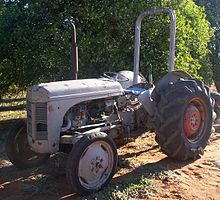
Ferguson TE 20 (Little Grey Fergie)
John Deere 9RX Series tractor

3. ‘Easy to use / Easy to repair’. What do these expressions have in common? Can you make new ones?

4. Translate the following sentences

a. Le TE 20 est plus sympa à regarder que le JD 9RX.

b. Le JD 9RX est plus à la pointe de la technologie que le TE 20.

c. Le TE 20 est en pire état que le JD 9RX.

d. Le TE 20 est plus écologique (vert) que le JD 9RX.

e. Le JD 9RX est le moins abordable du marché.

f. Le TE 20 est aussi facile à utiliser que le JD 9RX.   


5. Write sentences using comparative and superlative about the Ferguson TE 20 and the John Deere 9RX


Ferguson TE 20
John Deere 9RX
Comparative

Il est plus …que


Il est moins … que


Il est aussi … que


Superlative

Il est le plus …


Il est le moins …


Downloadable versions of the worksheets:


Students learn adjectives to talk about a vehicle, revise how to use the comparative and superlative, and practice their writing and speaking skills.

Students learn adjectives to talk about a vehicle, revise how to use the comparative and superlative, and practice their writing and speaking skills.


More grammar in context lessons:


Talk About the News Using Past Simple: A Grammar in Context Lesson

TEDx Talk Listening, Grammar and Pronunciation Skills Lesson: How to Introduce Yourself, Present Perfect Progressive, Since and For 

Cécile Sohier 

---

About the Author

Cécile Sohier is an English teacher specialising in Technical English, ESP (English for Specific Purposes), Business English, and EFL/ESL teaching. She creates classroom-ready resources and shares practical ideas for teaching English in secondary schools, vocational education, and professional contexts.

Teaching Technical English focuses on:
• Technical English vocabulary and communication
• ESP lesson plans and teaching strategies
• Business English activities and resources
• EFL/ESL classroom materials for teachers
• Practical English for real-life and workplace situations

All articles are written to support English teachers, language educators, and learners looking for clear, usable, and authentic teaching materials.

© Cécile Sohier – Teaching Technical English

---

Monday, 27 November 2017

Vocabulary Games: General Vocabulary of Farming and Farm Equipment

Students learn or revise some general vocabulary of farming and farm equipment through a guessing game, as well as other vocabulary games, and practise their speaking and listening skills. 


On this document, I have compiled 30 words related to farming and farm equipment (verbs and nouns). 


You can use this document in various ways.

A. Here is what I did:


1. Separate the class into groups of 4 or 5
2. Cut the words (1 worksheet/group)
3. Give each group a set of words and ask them to share the words evenly between each student in the group.
4. Ask students to write a definition of each word they have been assigned. 

This equipment is used to...
It is an action. When you do this, you.... for instance...
It is the opposite of...

5. Play a guessing game. Each group picks a word and explains it to the other groups.  You can get groups to compete against one another and score points.


B. But you can also:


1. Get students to play in their group. Each student reads its definitions and the rest of the group has to guess the word.

2. One student picks a card, shows it to the rest of the group but cannot look at it. He has to ask questions until he guesses what the word is.

3. The last man standing game: the first student gives a word from the list and throws a ball (or any other object) to another student, who then has to give another word from the list. Those who cannot think of a word that hasn't been said already are out.

4. Bingo: ask students to write the words of their choice from the list in a grid of 4 by 3 for instance. Then you can say the word in their first language and they have to cross out the word in English. You can also explain the word in English, or ask a student to explain the word. The first student to cross out all the words on their grid wins. 

Cécile Sohier 

---

About the Author

Cécile Sohier is an English teacher specialising in Technical English, ESP (English for Specific Purposes), Business English, and EFL/ESL teaching. She creates classroom-ready resources and shares practical ideas for teaching English in secondary schools, vocational education, and professional contexts.

Teaching Technical English focuses on:
• Technical English vocabulary and communication
• ESP lesson plans and teaching strategies
• Business English activities and resources
• EFL/ESL classroom materials for teachers
• Practical English for real-life and workplace situations

All articles are written to support English teachers, language educators, and learners looking for clear, usable, and authentic teaching materials.

© Cécile Sohier – Teaching Technical English

---

Monday, 13 November 2017

A Future with Farmers TEDx Listening, Reading and Speaking Lesson

A listening to practice the vocabulary of farming and learn about the differences between traditional commodity corn farming and a new trend of young farmers, who grow vegetables and rear animals on pastures.


Lindsay Lusher delivers a very inspiring speech on organic farming (without ever mentioning the word organic). In the extract I have picked, her focus is on the benefits for the community in terms of jobs and profits for example. She presents her farm, where she produces eggs and grows vegetables with an Allis-Chalmers G tractor, and then she goes on comparing it to growing commodity corn. 

This is the second listening activity that I make from a TEDx conference - the first being Pushing the Boundaries in Agriculture. It can be used as a conclusion after studying general farming vocabulary with parody songs and after they created their farmer profile.


1. Listening


This listening is a good way to practice general farming vocabulary such as to grow, to produce, to cultivate, to feed, different animal names, grass, corn, a farmer, a farm operation, land, acres, input... But also more business orientated vocabulary: to provide jobs, to gross, to maximize the value, to spend (money) on... (labour, fossil fuels), benefits, a paycheck, employees, seasonally, year-round, goods and services, a percentage, a budget..


2. Reading


After they complete the gap-fill exercise, they can work on a more in-depth comprehension of the transcript, and notably the differences between the two farming models. This can be achieved by getting the students to fill out a double-entry chart: on the left side Ben and Lindsay's organic farm and on the right side commodity corn farming. That would allow them to contrast the information provided about both models like the profits, the size, the number of jobs created...


3. Worksheet

BUILDING A FUTURE WITH FARMERS


  1. From the title and the words below imagine what the talk is about.
food, local job creation, by hand, community, commodity corn, fossil fuel, GMO, input, a million more farmers


  1. Listen and take notes. Then complete the transcript.


  1. Comparing two farming models


Lindsay
Commodity corn
………………….


Corn
………………….
25 acres
25 acres
Gross Income


Number of employees/amount spent on labour


……………………………………………………………………………...
N/A
5000 acres, half of the size of Clairmont New York
Budget expenditures


Benefits for the community


  1. Speaking and writing:


  1. “The more farmers you have maximizing the value of the land, the more benefits a community can experience.”
  • What kind of benefits is she talking about?


  1. “The more a farmer can care for the land, the more that land gives back.”
  • How does a farmer care for the land?


  • How does the land give back?


  1. “We need farmers, we need a million more farmers.”
  • Why would having a million more farmers be a good thing for rural areas?


  • What is wrong with the commodity corn system according to her?


  1. You interview Lindsay and her husband. Write the questions and answers using her talk.


It is also a good opportunity to review the difference between need, can and able to.


Worksheets and audio


This is the video extract that I use in this lesson:


But the full video can be watched by clicking on the link below:


Here is the transcript / gap-fill exercise and the worksheet:


A listening to practice the vocabulary of farming and learn about the differences between traditional commodity corn farming and a new trend of young farmers, who grow vegetables and rear animals on pastures.

Cécile Sohier 

---

About the Author

Cécile Sohier is an English teacher specialising in Technical English, ESP (English for Specific Purposes), Business English, and EFL/ESL teaching. She creates classroom-ready resources and shares practical ideas for teaching English in secondary schools, vocational education, and professional contexts.

Teaching Technical English focuses on:
• Technical English vocabulary and communication
• ESP lesson plans and teaching strategies
• Business English activities and resources
• EFL/ESL classroom materials for teachers
• Practical English for real-life and workplace situations

All articles are written to support English teachers, language educators, and learners looking for clear, usable, and authentic teaching materials.

© Cécile Sohier – Teaching Technical English

---

Monday, 23 October 2017

Talk About the News Using Past Simple: A Grammar in Context Lesson

Students revise/learn how to form and use past simple, and put this grammar point into practice by writing about the news. 


This lesson is a continuation of 2017 News and Words of the News: Speaking, Listening and Writing Activities.

You will find a downloadable jpeg document at the end of this post.


TALK ABOUT THE NEWS
using past simple


  1. Complete the following chart:


She announced
They didn’t go
Did he decide?
Le passé simple ou prétérit se forme de cette façon:

Affirmatif: …………………………+..........................+........................(sauf pour…………………………....)
Négatif:  …………………………+..........................+............................+.......................
Interrogatif: …………………………+..........................+............................
Il s’utilise pour:

  • …………………………………………………………………………………………………………………………………………………
  • …………………………………………………………………………………………………………………………………………………


  1. Translate the following expressions of time:


Il y a trois jours

Il y a une semaine

Il y a 20 ans

Hier / avant-hier
En juin dernier

Mardi dernier / Jeudi dernier

L’année dernière

La semaine dernière
En 2009 / en mars

Le 20 janvier 2017

pendant les élections

Mercredi à 8.00 du matin


  1. Practice exercise. Translate the following sentences:


  1. Le président a fait un discours.


  1. L’ouragan n’a pas frappé le nord des Etats-Unis.


  1. Volkswagen a menti sur les émissions de gaz de ses voitures diesel.


  1. Brad Pitt n’est pas mort en 2016.


  1. Trump s’est retiré des accords de Paris sur le changement climatique.


  1. Il y a eu plusieurs attentats.


  1. Les attentats ont tué beaucoup de gens.


  1. Transform the sentences from exercise 3 into questions.

Students revise how to form past simple, and put this grammar point into practice by writing about the news.


See also more grammar lessons:


Cécile Sohier 

---

About the Author

Cécile Sohier is an English teacher specialising in Technical English, ESP (English for Specific Purposes), Business English, and EFL/ESL teaching. She creates classroom-ready resources and shares practical ideas for teaching English in secondary schools, vocational education, and professional contexts.

Teaching Technical English focuses on:
• Technical English vocabulary and communication
• ESP lesson plans and teaching strategies
• Business English activities and resources
• EFL/ESL classroom materials for teachers
• Practical English for real-life and workplace situations

All articles are written to support English teachers, language educators, and learners looking for clear, usable, and authentic teaching materials.

© Cécile Sohier – Teaching Technical English

---

Thursday, 12 October 2017

2017 News quiz

Students learn and practice current affairs vocabulary through a vocabulary quiz about 2017 news.


Cécile Sohier