Showing posts with label Write. Show all posts

Thursday, 6 June 2019

BTS Final Oral Exam (CCF): Example of Assessment Paper and Useful Expressions

Students learn how to present orally a set of documents using the appropriate expressions (linking words, verbs...) and practise their reading, writing and speaking skills. 

(CCF exam paper for final oral exam of BTS students and possible production) 


In this post, you will find an assessment paper that I made last year to prepare students for their final oral exam (BTS TSMA Sujet CCF), along with an example of what a possible presentation might look like. 

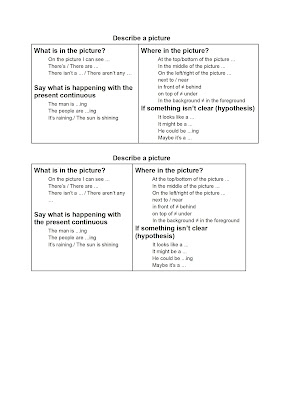
I have also included lists of useful expressions that I put together and that can be used to describe a picture, to make a presentation and to talk about a text. 

1. Assessment paper (BTS TSMA Situation d'évaluation 1 Sujet CCF)


Document 1: Article


When and Why to Hire a Full-Time Agronomist


“Our advice is unbiased regarding inputs; whether you spray or don’t spray or what seed you choose has no effect on us. Customers feel like this is a place where they can get good advice from our agronomists...”


It was apparent and became more so over time, that the agronomic decisions producers are making depend on the equipment. And it’s important that we understand those agronomic intentions so that we can ensure the machine is delivering what the producer wants. Our belief has grown stronger over time that we, as an equipment dealer, must understand this.


Hiring Agronomists for an Iron Dealership
Students learn how to present orally a set of documents using the appropriate expressions (linking words, verbs...) and practise their reading, writing and speaking skills.  (CCF exam paper for final oral exam of BTS students and possible production)


Our intention in hiring an agronomist was to understand the relationship between the equipment and the seed, nutrient and application prescriptions. Being on staff, he would deal with the prescriptions to equipment and potentially develop prescriptions for farmers who had the technology on their seeding and spraying equipment. The first thing that was obvious was the need for an experienced agronomist because our reputation would depend on the advice given out. Providing professional advice on how much of an input to put down is a significant decision and we needed someone with a good track record. That certainly was the right decision. Plus, it also helped on the revenue side to have someone come in with a plan of what they can bring to the table. The agronomist we hired had about 10 years of experience, with a fair amount of clients who were common customers.


Document 2: Picture

Students learn how to present orally a set of documents using the appropriate expressions (linking words, verbs...) and practise their reading, writing and speaking skills.  (CCF exam paper for final oral exam of BTS students and possible production)


2. Possible production (BTS TSMA Situation d'évaluation 1 Sujet CCF)


AGRONOMY, FARMERS AND DEALERSHIPS


This set of documents consists of 1 text - an article which was taken from the website “farmequipment.com” (dot com) and 2 pictures. It deals with agronomy, farming and farm equipment. The core of the question is what are the links between agronomy, farming and farm equipment. Also, it raises the issue of what agronomists can bring to farmers and dealerships in terms of equipment use, yield improvement, farm management, and also reputation building.


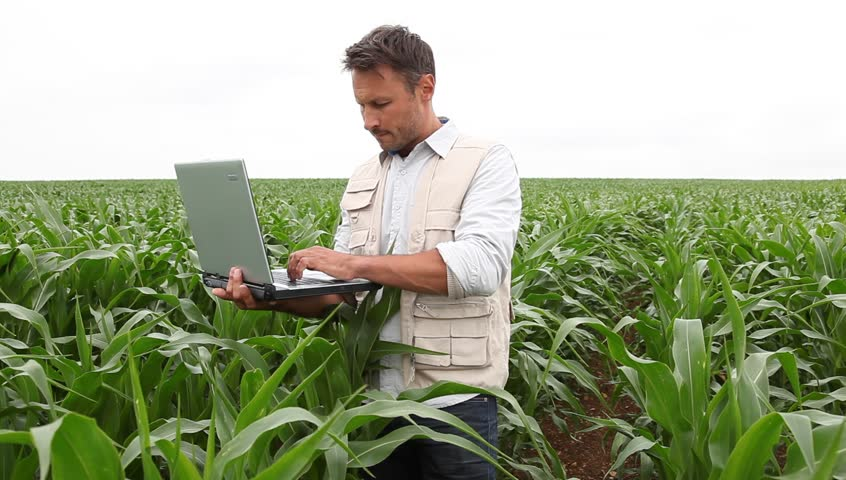
First, agronomy is a key element in farming. Farmers rely on machines for their work and it is paramount (very important) that they know how to use it and take the full advantage of it. In the text, the author argues that the expertise of the agronomist can help the farmer figure out (understand) how to use the equipment that they have by for instance telling them how much fertilizer or nutrient to spray on their crop. The first picture shows a man holding a computer in the middle of a cornfield and there is no doubt that he is an agronomist. With his computer, he analyses the field with precision farming tools. Those tools are designed to gather (rassembler) data about the soil, the crop, the weather … etc… so they give valuable information to the agronomist, who can then advise the farmers on the amount of nutrient that the crop needs for example.


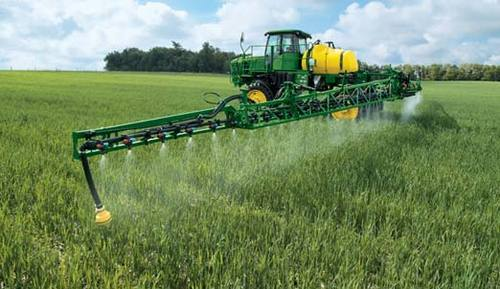
Also, because agronomists are so valuable to farming, they can be a great addition to a dealership providing (pourvu que) they have enough experience and already existing customers, who would then become dealership’s customers. Indeed in the second part of the text, the author points out that hiring an agronomist is a great way to consolidate a dealership reputation and increase their income. The dealership can sell their equipment and have an in-house agronomist who gives useful advice to the farmer on how to make the most of it. For example on the second picture, the equipment is a self-propelled sprayer. We can’t see the logo but the green and yellow colours indicate that is a John Deere. Only John Deere can put these colours together on their farm equipment. Another brand recently tried to use them and John Deere sued them in court in the US and won. So green and yellow are officially and unmistakably part of John Deere’s trademark. Such equipment is used to spray inputs on the crop and thanks to the in-house agronomist, the dealership can give extensive advice to the farmers so that they are able to achieve their goals in terms yields. In doing that, he builds himself a reputation and strengthens his link with the farmers.


In my opinion, the documents - and especially the article - are very interesting and informative. It presents a useful and efficient way for the dealership to increase their list of clients and therefore also their income. Nowadays with the increasing number of pollution issues and the fact that the world population is about to reach 9 billion people in 2050, I believe that agronomy has an important role to play in order the help farmers meet the world’s needs and reduce the environmental risks linked to pollution and global warming.


(537 words)

3. Lists of useful expressions

Students learn how to present orally a set of documents using the appropriate expressions (linking words, verbs...) and practise their reading, writing and speaking skills.  (CCF exam paper for final oral exam of BTS students and possible production)eaching Mecanical and technical English in BTS. Expressions utiles pour pour enseigner à faire des exposés, décrire une photo ou un texte, et préparer les étudiants au CCF du BTS industriel TSMA.

 
Fiche d'expressions utiles pour les exposés en anglais.

Fiche d'expressions utiles pour décrire une photo.


Fiche d'expressions utiles pour parler d'un texte.


---

About the Author

Cécile Sohier is an English teacher specialising in Technical English, ESP (English for Specific Purposes), Business English, and EFL/ESL teaching. She creates classroom-ready resources and shares practical ideas for teaching English in secondary schools, vocational education, and professional contexts.

Teaching Technical English focuses on:
• Technical English vocabulary and communication
• ESP lesson plans and teaching strategies
• Business English activities and resources
• EFL/ESL classroom materials for teachers
• Practical English for real-life and workplace situations

All articles are written to support English teachers, language educators, and learners looking for clear, usable, and authentic teaching materials.

© Cécile Sohier – Teaching Technical English

---


Saturday, 17 November 2018

First Lessons: ABC, Numbers and Past Simple (Speaking, Listening and Writing Activities)

Plenty of ideas on what to teach or revise with students during a first lesson: ranging from numbers, the ABC to past simple.


In this post, you will find activities and worksheets on:

1. Numbers

2. The ABC

3. Past Simple (Speaking Activity Holiday Liars)


1. Numbers


What students ought to know very well when they learn technical English are numbers. Therefore it is useful to revise them at the very beginning ... and also a few times along the way ;)

Numbers worksheet

Numbers powerpoint answers

Once you have been through numbers, you can get students to play a guessing game with numbers to practise saying and listening to numbers. Student A chooses a number and the rest of the group has to guess which number it is. Students A has to tell students if the number that he has in mind is higher or lower by saying 'more' or 'less'.

Example:
B. 500
A. more
C. 1000
A. less
D. 750
A. more
...

Finally, you can introduce them to the American pronunciation of numbers. Students are often taken aback by the American pronunciation of numbers, which leads them to miss crucial information during listening activities. Here is a listening activity for them to practice understanding numbers when they are said by North-American people within a flow of spoken information, namely a presentation.

Students listen and write down 4 numbers that are said by R. Saik during the first minute of his TedxTalk.

Pushing the Boundaries of Agriculture

There is a whole set of activities based on this talk in this article:

 TEDx Talk Listening, Grammar and Pronunciation Skills Lesson: How to Introduce Yourself, Present Perfect Progressive, Since and For  


2. ABC

The objective is to revise the pronunciation of the letters of the alphabet and more specifically those that are confusing for students such as A, E, I, G, J, R.

ABC sounds

Then by spelling PARIS, you can check if students really got their heads around the pronunciation of A, I and R. Then they can practise in groups by choosing names of places, people and/or technical references of parts or vehicles


3. Grammar

Here is a speaking activity that will enable your students to practise speaking using the past tense, while also practising their listening skills.

Holiday Liars: Students talk about their summer break, whether they worked or just stayed home. But they must include a lie. The rest of the class has to listen and find the false element in their description.

It is a good idea to revise the pronunciation of -ed beforehand through a simple exercise like this one:

Pronunciation of -ed

You can also find an A3 printable poster of my making for the classroom in this article:

Poster: Pronunciation of Final -ED

Cécile Sohier 

---

About the Author

Cécile Sohier is an English teacher specialising in Technical English, ESP (English for Specific Purposes), Business English, and EFL/ESL teaching. She creates classroom-ready resources and shares practical ideas for teaching English in secondary schools, vocational education, and professional contexts.

Teaching Technical English focuses on:
• Technical English vocabulary and communication
• ESP lesson plans and teaching strategies
• Business English activities and resources
• EFL/ESL classroom materials for teachers
• Practical English for real-life and workplace situations

All articles are written to support English teachers, language educators, and learners looking for clear, usable, and authentic teaching materials.

© Cécile Sohier – Teaching Technical English

---

Wednesday, 7 February 2018

Farmer Interview - Teaching the Vocabulary of Farming: Writing and Speaking Lesson

Students learn the vocabulary of farming, revise how to make questions, and practise their speaking, listening and writing skills.


As a final task and after they wrote their own "farming parody", I got the students to make up the profile of farmers, who became famous making videos about their farm.

The first step is to create the farmers' profiles. They will have to give them a name, decide what they are famous for (videos, songs, invention...), and create a farm with machines, tools, cattle and/or crops. They also have to explain what they like or don't like doing on the farm, and why they decided to become farmers.


This writing activity is followed up by a speaking activity in which students role-play an interview of the farmers.

You can find the worksheet below:

Farming Parody Stars Worksheet


Teaching ressources activities materials lesson plans. Farming English: Create a farmer profile and an interview.   General farming vocabulary. Speaking and writing activities.
Cécile Sohier 
---

About the Author

Cécile Sohier is an English teacher specialising in Technical English, ESP (English for Specific Purposes), Business English, and EFL/ESL teaching. She creates classroom-ready resources and shares practical ideas for teaching English in secondary schools, vocational education, and professional contexts.

Teaching Technical English focuses on:
• Technical English vocabulary and communication
• ESP lesson plans and teaching strategies
• Business English activities and resources
• EFL/ESL classroom materials for teachers
• Practical English for real-life and workplace situations

All articles are written to support English teachers, language educators, and learners looking for clear, usable, and authentic teaching materials.

© Cécile Sohier – Teaching Technical English

---

Friday, 12 January 2018

Fixing Tractor Hydraulics: Listening Activity to Learn English for Mechanics

Students learn how to easily fix a tractor hydraulic pump, as well as some technical English for mechanics, and practise their listening, writing and speaking skills.


After learning some vocabulary of farming through a song parody, I eventually decided to gather up my courage to get to the crux of the matter: how to talk about tractor mechanics in English. And particularly how to explain where a failure comes from and/or how to find a given failure on a vehicle.

Dare I say, I am drawing away from my comfort zone as my mechanical knowledge is close to zero. But it is time to man up and give my students what they really are craving for: some real technical vocabulary.

This video, along with the exercises I created, are a good starting point. The technique she presents, as well as the vocabulary, are rather simple and useful.

She explains and demonstrates how to fix tractor hydraulics by putting pressure into the reservoir with a blow-off nozzle. The only drawback of the video a little background noise so it is paramount to make sure the loudspeakers are up to the task, and make a clear and loud sound.

You can find the worksheet by clicking on the link below:

How to easily fix tractor hydraulics exercises and transcript


The video is available on youtube:

How to easily fix tractor hydraulics


This listening activity can be followed by another one, which contains much more technical vocabulary:

Why won't my tractor work

Students learn how to easily fix a tractor hydraulic pump, as well as some general mechanical vocabulary, and practise their listening, writing and speaking skills.Students learn how to easily fix a tractor hydraulic pump, as well as some general mechanical vocabulary, and practise their listening, writing and speaking skills.

More articles on English for Mechanics:

Fixing Tractor Hydraulics: Listening Activity to Learn English for Mechanics

Tractor Transmission: Mechanics Vocabulary Quiz

Tractor Troubleshooting Vocabulary Speaking Lesson

Tractor Buying Facts: Reading Activity and Oral Presentation Skills Practice

Tractor Troubleshooting English for Mechanics Listening Lesson

Tractor Warranty Issue / English for Mechanics: Listening and Speaking Exercises - BTS Final Exam (CCF)

Cécile Sohier 

---

About the Author

Cécile Sohier is an English teacher specialising in Technical English, ESP (English for Specific Purposes), Business English, and EFL/ESL teaching. She creates classroom-ready resources and shares practical ideas for teaching English in secondary schools, vocational education, and professional contexts.

Teaching Technical English focuses on:
• Technical English vocabulary and communication
• ESP lesson plans and teaching strategies
• Business English activities and resources
• EFL/ESL classroom materials for teachers
• Practical English for real-life and workplace situations

All articles are written to support English teachers, language educators, and learners looking for clear, usable, and authentic teaching materials.

© Cécile Sohier – Teaching Technical English

---

Tuesday, 19 December 2017

General Vocabulary of Farming: Phonetics, Intonation and Pronunciation

Students revise the general vocabulary of farming, learn/revise the pronunciation of the words (stress, sounds and intonation), and practise their listening, speaking and writing skills.


GENERAL VOCABULARY OF FARMING

  1. Stress. Listen and underline the stressed syllable:
Audio exercise 1

tractor
dealership
harvest
combine harvester
forage
silage
baler
seeder
pesticide
fertilizer
manufacturer
tillage
manure


  1. Sounds. Put the words below in the right column.
Audio Exercise 2

bale
wheat
dirt
seeder
combine
pesticide
fertilizer
dealer
dealership
silage
field
tillage
wheel
hydraulic
yield

/ei/
/i:/
/i/
/ɜː/ (bird)
/ai/


  1. Sounds. Put the words above in plural and put them in the right column.

/s/
/iz/
/z/
harvests


  1. Intonation. Repeat the sentences below, then try to repeat giving at least 2 different intonations.
Audio Exercise 4

This tractor is efficient.

Fertilizers increase the yield.

Tillage is important.

Combines harvest the crop.

Balers make bales with silage.

Dealerships sell seeders and balers.

Sprayers spray fertilizers and pesticides.

Cécile Sohier 

---

About the Author

Cécile Sohier is an English teacher specialising in Technical English, ESP (English for Specific Purposes), Business English, and EFL/ESL teaching. She creates classroom-ready resources and shares practical ideas for teaching English in secondary schools, vocational education, and professional contexts.

Teaching Technical English focuses on:
• Technical English vocabulary and communication
• ESP lesson plans and teaching strategies
• Business English activities and resources
• EFL/ESL classroom materials for teachers
• Practical English for real-life and workplace situations

All articles are written to support English teachers, language educators, and learners looking for clear, usable, and authentic teaching materials.

© Cécile Sohier – Teaching Technical English

---


Tuesday, 12 December 2017

Talk about Vehicles and Tractors Using Comparative and Superlative: a Vocabulary and Grammar In Context Lesson

Students learn adjectives to talk about a vehicle, revise how to use the comparative and superlative, and practise their writing and speaking skills.


Talk about a tractor

1. Comparative/Superlative


Big

(adjectifs d’une syllabe et ceux de
deux syllabes qui finissent par
-e, -y, -ow)
Expensive

(adjectif de plus de deux syllabes et
ceux de deux syllabes qui ne
terminent pas par -e, -y, -ow)
Comparative
plus …que
moins … que
aussi … que

bigger than
less big than
as big as

more expensive than
less expensive than
as expensive as
Superlative
le plus …
le moins …

the biggest
the least big

the most expensive
the least expensive


Exceptions: good ⇒ better than / the best, bad⇒ worse than / the worst

2. Match each adjective below with either the Little Grey Fergie or the John Deere 9RX series:


reliable / robust / durable
efficient
state-of-the-art / innovative ≠ obsolete / outdated
in good condition ≠ in bad condition
heavy ≠ light
manoeuvrable / easy to manoeuvre / easy to drive
easy to use / easy to repair
safe ≠  dangerous
useful ≠ useless
customized
user-friendly
powerful, big ≠ small
expensive / costly ≠ cheap / affordable / economical
fast ≠ slow
beautiful / nice to look at ≠ ugly
polluting ≠ environmentally friendly, green
large ≠ narrow
recent ≠ old
comfortable ≠ uncomfortable
versatile, intuitive
enhanced, improved
optimal


Ferguson TE 20 (Little Grey Fergie)
John Deere 9RX Series tractor

3. ‘Easy to use / Easy to repair’. What do these expressions have in common? Can you make new ones?

4. Translate the following sentences

a. Le TE 20 est plus sympa à regarder que le JD 9RX.

b. Le JD 9RX est plus à la pointe de la technologie que le TE 20.

c. Le TE 20 est en pire état que le JD 9RX.

d. Le TE 20 est plus écologique (vert) que le JD 9RX.

e. Le JD 9RX est le moins abordable du marché.

f. Le TE 20 est aussi facile à utiliser que le JD 9RX.   


5. Write sentences using comparative and superlative about the Ferguson TE 20 and the John Deere 9RX


Ferguson TE 20
John Deere 9RX
Comparative

Il est plus …que


Il est moins … que


Il est aussi … que


Superlative

Il est le plus …


Il est le moins …


Downloadable versions of the worksheets:


Students learn adjectives to talk about a vehicle, revise how to use the comparative and superlative, and practice their writing and speaking skills.

Students learn adjectives to talk about a vehicle, revise how to use the comparative and superlative, and practice their writing and speaking skills.


More grammar in context lessons:


Talk About the News Using Past Simple: A Grammar in Context Lesson

TEDx Talk Listening, Grammar and Pronunciation Skills Lesson: How to Introduce Yourself, Present Perfect Progressive, Since and For 

Cécile Sohier 

---

About the Author

Cécile Sohier is an English teacher specialising in Technical English, ESP (English for Specific Purposes), Business English, and EFL/ESL teaching. She creates classroom-ready resources and shares practical ideas for teaching English in secondary schools, vocational education, and professional contexts.

Teaching Technical English focuses on:
• Technical English vocabulary and communication
• ESP lesson plans and teaching strategies
• Business English activities and resources
• EFL/ESL classroom materials for teachers
• Practical English for real-life and workplace situations

All articles are written to support English teachers, language educators, and learners looking for clear, usable, and authentic teaching materials.

© Cécile Sohier – Teaching Technical English

---