Showing posts with label STI2D. Show all posts

Friday, 23 February 2018

Debate Competition: a Speaking and Listening Activity

Students take part in a debate in form of a game/competition and practise their speaking and listening skills.


The best way to describe this activity is as simple as its name: it is a debate, but it is also a competition. Therefore it is a game with rules, where you score points.

In this competition, there are positive and negative points. The rules are as follows:

1. How to score positive points:


Every new, understandable and relevant argument scores a point.

2. How to score negative points:


Every time a team member speaks French.
If a team member has not spoken by the end of the debate.


So there are two main rules to win this competition: everyone in a team has to speak and they have to speak English!

I came up with a template to write down the points for each team.

Debate ideas are:
- Being a farmer/mechanic is a great job.
- Tractors have not changed in the last 100 years.
- Tractors should be replaced by robots or other innovations.
- Oil energy is great.
- Apple is better than Samsung.
- Video games are better than sports.
- You have to get a university degree to get a good job.
- Chemical inputs are necessary to grow food.
- New Holland equipment is better than John Deere.
- Organic is better than industrial farming.
- The United States vs France
- Football vs Rugby
- Speed limitation is necessary to reduce the number of deaths on the road
- Marvel vs DC Comics


Debate Competition Template

Students take part in a debate in form of a game/competition and practise their speaking and listening skills.

Cécile Sohier 

---

About the Author

Cécile Sohier is an English teacher specialising in Technical English, ESP (English for Specific Purposes), Business English, and EFL/ESL teaching. She creates classroom-ready resources and shares practical ideas for teaching English in secondary schools, vocational education, and professional contexts.

Teaching Technical English focuses on:
• Technical English vocabulary and communication
• ESP lesson plans and teaching strategies
• Business English activities and resources
• EFL/ESL classroom materials for teachers
• Practical English for real-life and workplace situations

All articles are written to support English teachers, language educators, and learners looking for clear, usable, and authentic teaching materials.

© Cécile Sohier – Teaching Technical English

---

Friday, 15 September 2017

Superheroes and History (the Example of Captain America): Reading, Writing and Speaking Activities

In this lesson, students analyse the link between history and superhero stories (through the example of Captain America), and practise their reading, speaking, and writing skills.


In this lesson, I really wanted to make students see superhero stories for more than mere stories of superdudes with cool superpowers (sadly they often fail to acknowledge that superheroines also exist). I have already led them to pinpoint patterns in superhero stories in Analysing superhero stories

Now students will have to describe/analyse two comic book covers and explain what is WWII, the Cold War, September 11th and the link between those historical events and Captain America.

I have selected two comic book covers that I find illustrate very well the evolution of Captain America through time, following the unfolding of American foreign diplomatic policies and issues. They are also very popular covers so please if you have any lead on more interesting/less well-known ones, don't hesitate to leave a comment with a suggestion :).

Also, to do exercise 4 on today's enemy of Captain America I asked students to read the first issue of Captain America comic book, which was published in the immediate aftermath of 9/11 terror attacks.


Click on the link or on the pictures below to see the worksheet (+ answers)

Superheroes and history - worksheet and answers 


See also related posts on Superhero activities:

Analysing superhero stories.

Superheroes Web Quest: Reading, Writing and Board Game Activities

In this lesson, students analyse the link between history and superhero stories through Captain America comic books, and practise their speaking, reading and writing skills.

In this lesson, students analyse the link between history and superhero stories through Captain America comic books, and practise their speaking, reading and writing skills.


Cécile Sohier 

---

About the Author

Cécile Sohier is an English teacher specialising in Technical English, ESP (English for Specific Purposes), Business English, and EFL/ESL teaching. She creates classroom-ready resources and shares practical ideas for teaching English in secondary schools, vocational education, and professional contexts.

Teaching Technical English focuses on:
• Technical English vocabulary and communication
• ESP lesson plans and teaching strategies
• Business English activities and resources
• EFL/ESL classroom materials for teachers
• Practical English for real-life and workplace situations

All articles are written to support English teachers, language educators, and learners looking for clear, usable, and authentic teaching materials.

© Cécile Sohier – Teaching Technical English

---

Monday, 17 July 2017

Create a Quiz with Google Forms: Vocabulary, Writing and Reading Activity

Students have fun creating a quiz with Google Forms, learn about any given topic or vocabulary, and practise their reading and writing skills.


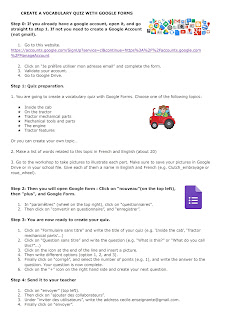
Here are the instructions for the students on how to proceed to create a quiz with Google Forms . You can also download the JPEG document at the end of this post. If you want to see the final results, you can check those quizzes that were made by my students: General Tractor Vocabulary Quiz and Tractor Transmission: Mechanics Vocabulary Quiz.


CREATE A VOCABULARY QUIZ WITH GOOGLE FORMS
Students have fun creating a quiz with Google Forms, learn about any given topic or vocabulary, and practise their reading and writing skills.

Step 0: If you already have a google account, open it, and go straight to step 1. If not you need to create a Google Account (not gmail).
https://accounts.google.com/SignUp?service=cl&continue=https%3A%2F%2Faccounts.google.com%2FManageAccount

1. Go to the above website.
2. Click on “Je préfère utiliser mon adresse email” and complete the form.
3. Validate your account.
4. Go to Google Drive.

Students have fun creating a quiz with Google Forms, learn about any given topic or vocabulary, and practise their reading and writing skills.Step 1: Quiz preparation.

1. You are going to create a vocabulary quiz with Google Forms. Choose one of the following topics:

  • Inside the cab
  • On the tractor
  • Tractor mechanical parts
  • Mechanical tools and parts
  • The engine
  • Tractor features

Or you can create your own topic…

2. Make a list of words related to this topic in French and English (about 20)

3. Go to the workshop to take pictures to illustrate each part. Make sure to save your pictures in Google Drive or in your school file. Give each of them a name in English and French (e.g. Clutch_embrayage or roue_wheel).

Students have fun creating a quiz with Google Forms, learn about any given topic or vocabulary, and practise their reading and writing skills.Step 2: Then you will open Google form : Click on “nouveau”(on the top left), then “plus”, and Google Form.

  1. In “paramêtres” (wheel on the top right), click on “questionnaires”.
  2. Then click on “convertir en questionnaire”, and “enregistrer”.

Step 3: You are now ready to create your quiz.

  1. Click on “Formulaire sans titre” and write the title of your quiz (e.g. ‘Inside the cab’, ‘Tractor mechanical parts’...)
  2. Click on “Question sans titre” and write the question (e.g. “What is this?” or “What do you call this?”...)
  3. Click on the icon at the end of the line and insert a picture.
  4. Then write different options (option 1, 2, and 3).
  5. Finally click on “corrigé”, and select the number of points (e.g. 1), and write the answer to the question. Your question is now complete.
  6. Click on the “+” icon on the right hand side and create your next question.

Step 4: Send it to your teacher

  1. Click on “envoyer” (top left).
  2. Then click on “ajouter des collaborateurs”.
  3. Under “inviter des utilisateurs”, write the address cecile.enseignante@gmail.com.
  4. Finally click on “envoyer”.

Here is the downloadable JPEG file:

Students have fun creating a quiz with Google Forms, learn about any given topic or vocabulary, and practise their reading and writing skills.

Cécile Sohier 


---

About the Author

Cécile Sohier is an English teacher specialising in Technical English, ESP (English for Specific Purposes), Business English, and EFL/ESL teaching. She creates classroom-ready resources and shares practical ideas for teaching English in secondary schools, vocational education, and professional contexts.

Teaching Technical English focuses on:
• Technical English vocabulary and communication
• ESP lesson plans and teaching strategies
• Business English activities and resources
• EFL/ESL classroom materials for teachers
• Practical English for real-life and workplace situations

All articles are written to support English teachers, language educators, and learners looking for clear, usable, and authentic teaching materials.

© Cécile Sohier – Teaching Technical English

---


Monday, 29 May 2017

Analysing Superheroes: Speaking, Writing and Listening Activities

Students synthesise everything they know about superheroes (and heroes) in order to analyse superhero stories, and practice their speaking, listening, and writing skills.


The main objective of these activities is to get students to talk about a familiar topic, as well as to understand the pattern behind superhero stories. The final task of this chapter will be to get the students to create their own superhero and present it to the class.

Students have made some diggings on superheroes through the Superheroes web quest (click here to read the post and access the worksheets). In teams, they have had to write questions on one superhero of their choice and then play a board game with questions from all teams. This activity gave common grounds to all of them to start analysing superhero stories.

In Analysing Superheroes worksheet (you will find the link at the bottom of this page), the key question is: "what makes a superhero?". So in exercise 1, we analyse different aspects of superhero stories to try and outline a pattern: how they became superheroes, what is their purpose, how they achieve their purpose and what type of characters we usually find in superhero stories. 

Exercise 2 focuses on how different superheroes and heroes are. We listen to a video ( the link in which young people give their definition of a hero. Ultimately I ask them to come up with their own personal definition that starts up with "a hero is someone who...".

Finally, in exercise 3 students are expected to think about the differences between superhero stories and the real life. How crime is dealt with in superhero stories as opposed to the real life for example. 

Eventually, I wanted to make them reflect upon the black and white vision of the world in superhero stories but it turned out to be a little ambitious (especially in the time lapse that we had). I was happy that they all came up with convincing reasons as for why people like superhero stories so much (exercise 4).

The activity worksheet is followed by a proposal of answers for each exercise.


Here is the worksheet (with answers on the second page)

Analysing Superheroes

This activity was preceded by a web search and board game creation

Superhero web quest

And it is followed by activities on comics covers (namely Captain America) and their link to major historical events:

Superheroes and History (the Example of Captain America): Reading, Writing and Speaking Activities


Students analyse superhero stories and practice their speaking, listening, and writing skills.

Students analyse superhero stories and practice their speaking, listening, and writing skills.
Cécile Sohier 

---

About the Author

Cécile Sohier is an English teacher specialising in Technical English, ESP (English for Specific Purposes), Business English, and EFL/ESL teaching. She creates classroom-ready resources and shares practical ideas for teaching English in secondary schools, vocational education, and professional contexts.

Teaching Technical English focuses on:
• Technical English vocabulary and communication
• ESP lesson plans and teaching strategies
• Business English activities and resources
• EFL/ESL classroom materials for teachers
• Practical English for real-life and workplace situations

All articles are written to support English teachers, language educators, and learners looking for clear, usable, and authentic teaching materials.

© Cécile Sohier – Teaching Technical English

---

Tuesday, 11 April 2017

Superheroes Web Quest: Reading, Writing and Board Game Activities

Students practice their reading and writing skills, as well as learn about different famous superhero stories, and revise the interrogative form.  


I believe superheroes are a great way to motivate students. They are alluring to them, not just because they are endowed with superpowers and fight the crime by killing supervillains, but also because they can relate to them. Superheroes are portrayed in an increasingly humane way in movies. They are super humans because of their super abilities, but they also have their fair share of trauma, bad dreams, fears, anxiety because they see their body changing or because their loved ones are in danger, typically they are victims of events they cannot control. From this standpoint, they are very much alike our teenager students.

These activities are intended as an introductory set of activities to a chapter on superheroes. I wanted to get them to think about what makes superheroes so special and so alluring. 

Students are required to choose a superhero and make some research (a webpage is provided to help) in order to make questions that will later be used in a board game. Initially, I wanted to focus on humans who became superheroes using technology (like Batman or the Green Harrow) but I ultimately allowed some students to work on Hulk or Deadpool. It took them a one-hour lesson to make the 12 questions and answers (depending on the groups, some made less), I then gathered all the questions on a single document and made copies for each group. 

To fit into the STI2D program, I have oriented the chapter as followed:

Cultural entry: Myths and heroes
Question: Why are superheroes such mythical heroes?

Technical knowledge: Technological innovations

Question: How do men manage to enhance their physical abilities to become superheroes?

Here is the worksheet for the web search: 

Superheroes web quest and board game

And a board game template:

Board game template

The follow-up activities are a reflection on superhero stories, as well as the link between superheroes and history:

Analysing superheroes

Superheroes and History (the Example of Captain America): Reading, Writing and Speaking Activities


Students practice their reading and writing skills, as well as learn about different famous superhero stories, and revise the interrogative form.

Cécile Sohier 

---

About the Author

Cécile Sohier is an English teacher specialising in Technical English, ESP (English for Specific Purposes), Business English, and EFL/ESL teaching. She creates classroom-ready resources and shares practical ideas for teaching English in secondary schools, vocational education, and professional contexts.

Teaching Technical English focuses on:
• Technical English vocabulary and communication
• ESP lesson plans and teaching strategies
• Business English activities and resources
• EFL/ESL classroom materials for teachers
• Practical English for real-life and workplace situations

All articles are written to support English teachers, language educators, and learners looking for clear, usable, and authentic teaching materials.

© Cécile Sohier – Teaching Technical English

---



Monday, 12 December 2016

Understanding the News: Dakota Access Pipeline Listening Activity.

Listening activity on 2 news reports about the Dakota Access Pipeline conflict.


Students learnt about the Sioux through the webquest. Now, in this listening exercise,they have to understand what is currently happening in North Dakota and the reasons why so many people are supporting the Sioux in their fight against a big oil pipeline company. 


Listening activity on 2 news reports about the Dakota Access Pipeline conflict. Exercice de compréhension orale.
Pour accéder aux vidéos concernées par l'exercice il suffit de cliquer sur les liens suivants :


Cécile Sohier 

---

About the Author

Cécile Sohier is an English teacher specialising in Technical English, ESP (English for Specific Purposes), Business English, and EFL/ESL teaching. She creates classroom-ready resources and shares practical ideas for teaching English in secondary schools, vocational education, and professional contexts.

Teaching Technical English focuses on:
• Technical English vocabulary and communication
• ESP lesson plans and teaching strategies
• Business English activities and resources
• EFL/ESL classroom materials for teachers
• Practical English for real-life and workplace situations

All articles are written to support English teachers, language educators, and learners looking for clear, usable, and authentic teaching materials.

© Cécile Sohier – Teaching Technical English

---

Saturday, 10 December 2016

Web quest: Native Americans in North Dakota

Teaching General English : webquest. Activité de recherche sur internet pour enseigner le vocabulaire et apprendre à connaitre les Indiens d'Amérique et l'actualité du Dakota du Nord et du Sud.

This summer I found out about this both surprising and dramatic conflict going on between Native Americans (particularly the Sioux) and an oil pipeline company.


A David vs Goliath fight over the construction of a pipeline... it just makes so much sense to study it with my students since it perfectly fits into the 'STI2D' syllabus! Plus it's a crude oil pipeline so it's also good to trigger a debate on sustainability. 

By way of introduction, I started with a webquest on the Sioux (where they live, how they used to live, what reservations are , what happened to the 1868 Great Reservation, what is Cannonball Ranch and the Black Snake Prophecy...) 

It took two 50 minute sessions for the students to be able to finish the web quest. And once they completed the webquest, I gave them this correction exercise. 

Then I followed up with this listening exercise.

Here are the elements of the syllabus this lesson could fit into:

Entrée culturelle :
L'idée de progrès / Espace et échange / Mythes et héros

Pole de connaissance : 
Matériaux et structures / Energie et environnement

Exemples de problématiques :

Quelle est la place des Indiens dans l’espace américain? L'exemple de la construction d'un pipeline.

Quels sont les problèmes que posent le passage d’un pipeline sur une terre sacrée indienne ?

Le mythe Sioux du serpent noir est-il entrain de se réaliser ?


Teaching General English : web quest. Activité de recherche sur internet pour enseigner le vocabulaire et apprendre à connaitre les Indiens d'Amérique et  l'actualité au Dakota du Sud.
Cécile Sohier 
---

About the Author

Cécile Sohier is an English teacher specialising in Technical English, ESP (English for Specific Purposes), Business English, and EFL/ESL teaching. She creates classroom-ready resources and shares practical ideas for teaching English in secondary schools, vocational education, and professional contexts.

Teaching Technical English focuses on:
• Technical English vocabulary and communication
• ESP lesson plans and teaching strategies
• Business English activities and resources
• EFL/ESL classroom materials for teachers
• Practical English for real-life and workplace situations

All articles are written to support English teachers, language educators, and learners looking for clear, usable, and authentic teaching materials.

© Cécile Sohier – Teaching Technical English

---