Showing posts with label Grammar. Show all posts

Friday, 1 February 2019

Tractor Failure: Contact Between a Customer and the Dealership. Speaking, Listening, and Grammar (past simple and progressive).

Students learn useful expressions to deal with a customer when diagnosing a mechanical breakdown, practise their speaking and listening skills through a role play, and revise how to talk about the past.


Useful expressions

Students learn useful expressions to deal with a customer when diagnosing a mechanical breakdown, practise their speaking and listening skills through a role play, and revise how to talk about the past.
Students can also practise and learn the expressions by using the following website that contains the dedicated list I created for them:


Grammar: Talk about what happened (past simple and progressive)

Students learn useful expressions to deal with a customer when diagnosing a mechanical breakdown, practise their speaking and listening skills through a role play, and revise how to talk about the past.


Roleplay

Writing:
Think of three mechanical issues farmers can have on their tractor.

(This list allowed me to create the flashcards below)

Speaking:
Imagine a dialogue between a farmer and a mechanic.
The farmer explains to the mechanic what is wrong with his tractor.
The mechanic asks questions to understand the problem and explains what he is going to do.

Students learn useful expressions to deal with a customer when diagnosing a mechanical breakdown, practise their speaking and listening skills through a role play, and revise how to talk about the past.


Rubric (evaluation chart)

Students learn useful expressions to deal with a customer when diagnosing a mechanical breakdown, practise their speaking and listening skills through a role play, and revise how to talk about the past.
Cécile Sohier 

---

About the Author

Cécile Sohier is an English teacher specialising in Technical English, ESP (English for Specific Purposes), Business English, and EFL/ESL teaching. She creates classroom-ready resources and shares practical ideas for teaching English in secondary schools, vocational education, and professional contexts.

Teaching Technical English focuses on:
• Technical English vocabulary and communication
• ESP lesson plans and teaching strategies
• Business English activities and resources
• EFL/ESL classroom materials for teachers
• Practical English for real-life and workplace situations

All articles are written to support English teachers, language educators, and learners looking for clear, usable, and authentic teaching materials.

© Cécile Sohier – Teaching Technical English

---

Saturday, 17 November 2018

First Lessons: ABC, Numbers and Past Simple (Speaking, Listening and Writing Activities)

Plenty of ideas on what to teach or revise with students during a first lesson: ranging from numbers, the ABC to past simple.


In this post, you will find activities and worksheets on:

1. Numbers

2. The ABC

3. Past Simple (Speaking Activity Holiday Liars)


1. Numbers


What students ought to know very well when they learn technical English are numbers. Therefore it is useful to revise them at the very beginning ... and also a few times along the way ;)

Numbers worksheet

Numbers powerpoint answers

Once you have been through numbers, you can get students to play a guessing game with numbers to practise saying and listening to numbers. Student A chooses a number and the rest of the group has to guess which number it is. Students A has to tell students if the number that he has in mind is higher or lower by saying 'more' or 'less'.

Example:
B. 500
A. more
C. 1000
A. less
D. 750
A. more
...

Finally, you can introduce them to the American pronunciation of numbers. Students are often taken aback by the American pronunciation of numbers, which leads them to miss crucial information during listening activities. Here is a listening activity for them to practice understanding numbers when they are said by North-American people within a flow of spoken information, namely a presentation.

Students listen and write down 4 numbers that are said by R. Saik during the first minute of his TedxTalk.

Pushing the Boundaries of Agriculture

There is a whole set of activities based on this talk in this article:

 TEDx Talk Listening, Grammar and Pronunciation Skills Lesson: How to Introduce Yourself, Present Perfect Progressive, Since and For  


2. ABC

The objective is to revise the pronunciation of the letters of the alphabet and more specifically those that are confusing for students such as A, E, I, G, J, R.

ABC sounds

Then by spelling PARIS, you can check if students really got their heads around the pronunciation of A, I and R. Then they can practise in groups by choosing names of places, people and/or technical references of parts or vehicles


3. Grammar

Here is a speaking activity that will enable your students to practise speaking using the past tense, while also practising their listening skills.

Holiday Liars: Students talk about their summer break, whether they worked or just stayed home. But they must include a lie. The rest of the class has to listen and find the false element in their description.

It is a good idea to revise the pronunciation of -ed beforehand through a simple exercise like this one:

Pronunciation of -ed

You can also find an A3 printable poster of my making for the classroom in this article:

Poster: Pronunciation of Final -ED

Cécile Sohier 

---

About the Author

Cécile Sohier is an English teacher specialising in Technical English, ESP (English for Specific Purposes), Business English, and EFL/ESL teaching. She creates classroom-ready resources and shares practical ideas for teaching English in secondary schools, vocational education, and professional contexts.

Teaching Technical English focuses on:
• Technical English vocabulary and communication
• ESP lesson plans and teaching strategies
• Business English activities and resources
• EFL/ESL classroom materials for teachers
• Practical English for real-life and workplace situations

All articles are written to support English teachers, language educators, and learners looking for clear, usable, and authentic teaching materials.

© Cécile Sohier – Teaching Technical English

---

Tuesday, 12 December 2017

Talk about Vehicles and Tractors Using Comparative and Superlative: a Vocabulary and Grammar In Context Lesson

Students learn adjectives to talk about a vehicle, revise how to use the comparative and superlative, and practise their writing and speaking skills.


Talk about a tractor

1. Comparative/Superlative


Big

(adjectifs d’une syllabe et ceux de
deux syllabes qui finissent par
-e, -y, -ow)
Expensive

(adjectif de plus de deux syllabes et
ceux de deux syllabes qui ne
terminent pas par -e, -y, -ow)
Comparative
plus …que
moins … que
aussi … que

bigger than
less big than
as big as

more expensive than
less expensive than
as expensive as
Superlative
le plus …
le moins …

the biggest
the least big

the most expensive
the least expensive


Exceptions: good ⇒ better than / the best, bad⇒ worse than / the worst

2. Match each adjective below with either the Little Grey Fergie or the John Deere 9RX series:


reliable / robust / durable
efficient
state-of-the-art / innovative ≠ obsolete / outdated
in good condition ≠ in bad condition
heavy ≠ light
manoeuvrable / easy to manoeuvre / easy to drive
easy to use / easy to repair
safe ≠  dangerous
useful ≠ useless
customized
user-friendly
powerful, big ≠ small
expensive / costly ≠ cheap / affordable / economical
fast ≠ slow
beautiful / nice to look at ≠ ugly
polluting ≠ environmentally friendly, green
large ≠ narrow
recent ≠ old
comfortable ≠ uncomfortable
versatile, intuitive
enhanced, improved
optimal


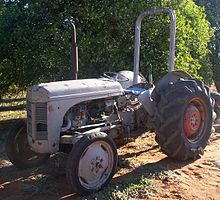
Ferguson TE 20 (Little Grey Fergie)
John Deere 9RX Series tractor

3. ‘Easy to use / Easy to repair’. What do these expressions have in common? Can you make new ones?

4. Translate the following sentences

a. Le TE 20 est plus sympa à regarder que le JD 9RX.

b. Le JD 9RX est plus à la pointe de la technologie que le TE 20.

c. Le TE 20 est en pire état que le JD 9RX.

d. Le TE 20 est plus écologique (vert) que le JD 9RX.

e. Le JD 9RX est le moins abordable du marché.

f. Le TE 20 est aussi facile à utiliser que le JD 9RX.   


5. Write sentences using comparative and superlative about the Ferguson TE 20 and the John Deere 9RX


Ferguson TE 20
John Deere 9RX
Comparative

Il est plus …que


Il est moins … que


Il est aussi … que


Superlative

Il est le plus …


Il est le moins …


Downloadable versions of the worksheets:


Students learn adjectives to talk about a vehicle, revise how to use the comparative and superlative, and practice their writing and speaking skills.

Students learn adjectives to talk about a vehicle, revise how to use the comparative and superlative, and practice their writing and speaking skills.


More grammar in context lessons:


Talk About the News Using Past Simple: A Grammar in Context Lesson

TEDx Talk Listening, Grammar and Pronunciation Skills Lesson: How to Introduce Yourself, Present Perfect Progressive, Since and For 

Cécile Sohier 

---

About the Author

Cécile Sohier is an English teacher specialising in Technical English, ESP (English for Specific Purposes), Business English, and EFL/ESL teaching. She creates classroom-ready resources and shares practical ideas for teaching English in secondary schools, vocational education, and professional contexts.

Teaching Technical English focuses on:
• Technical English vocabulary and communication
• ESP lesson plans and teaching strategies
• Business English activities and resources
• EFL/ESL classroom materials for teachers
• Practical English for real-life and workplace situations

All articles are written to support English teachers, language educators, and learners looking for clear, usable, and authentic teaching materials.

© Cécile Sohier – Teaching Technical English

---
Monday, 23 October 2017

Talk About the News Using Past Simple: A Grammar in Context Lesson

Students revise/learn how to form and use past simple, and put this grammar point into practice by writing about the news. 


This lesson is a continuation of 2017 News and Words of the News: Speaking, Listening and Writing Activities.

You will find a downloadable jpeg document at the end of this post.


TALK ABOUT THE NEWS
using past simple


  1. Complete the following chart:


She announced
They didn’t go
Did he decide?
Le passé simple ou prétérit se forme de cette façon:

Affirmatif: …………………………+..........................+........................(sauf pour…………………………....)
Négatif:  …………………………+..........................+............................+.......................
Interrogatif: …………………………+..........................+............................
Il s’utilise pour:

  • …………………………………………………………………………………………………………………………………………………
  • …………………………………………………………………………………………………………………………………………………


  1. Translate the following expressions of time:


Il y a trois jours

Il y a une semaine

Il y a 20 ans

Hier / avant-hier
En juin dernier

Mardi dernier / Jeudi dernier

L’année dernière

La semaine dernière
En 2009 / en mars

Le 20 janvier 2017

pendant les élections

Mercredi à 8.00 du matin


  1. Practice exercise. Translate the following sentences:


  1. Le président a fait un discours.


  1. L’ouragan n’a pas frappé le nord des Etats-Unis.


  1. Volkswagen a menti sur les émissions de gaz de ses voitures diesel.


  1. Brad Pitt n’est pas mort en 2016.


  1. Trump s’est retiré des accords de Paris sur le changement climatique.


  1. Il y a eu plusieurs attentats.


  1. Les attentats ont tué beaucoup de gens.


  1. Transform the sentences from exercise 3 into questions.

Students revise how to form past simple, and put this grammar point into practice by writing about the news.


See also more grammar lessons:


Cécile Sohier 

---

About the Author

Cécile Sohier is an English teacher specialising in Technical English, ESP (English for Specific Purposes), Business English, and EFL/ESL teaching. She creates classroom-ready resources and shares practical ideas for teaching English in secondary schools, vocational education, and professional contexts.

Teaching Technical English focuses on:
• Technical English vocabulary and communication
• ESP lesson plans and teaching strategies
• Business English activities and resources
• EFL/ESL classroom materials for teachers
• Practical English for real-life and workplace situations

All articles are written to support English teachers, language educators, and learners looking for clear, usable, and authentic teaching materials.

© Cécile Sohier – Teaching Technical English

---